

Software teams running AI coding tools are generating more output than ever before. Commits are up. Pull requests move faster. By the numbers, developer productivity is what the tools promised.
Delivery performance is a different story. Many organizations report that deployments have slowed and governance overhead has grown. The AI tools worked. The system around them did not scale with them.
The bottleneck has moved
When code generation accelerates, pressure accumulates downstream. Code review cycles that were manageable at human writing speed become the constraint when AI-assisted developers generate two or three times the volume. Testing pipelines face higher throughput demands. Security and compliance checks arrive more frequently. Documentation falls behind. Deployment approvals become a queue.
The tools addressed one part of the delivery chain. The rest of the chain remained organized for a slower world.
Research from McKinsey shows that the companies capturing meaningful value from AI are doing so by redesigning workflows, not just deploying tools. The organizations gaining the most have moved beyond individual productivity gains to change how work is organized at the system level. That finding shows up consistently across industries, and software engineering is no exception.
Coherent Solutions
Coordination as an engineering problem
What AI-assisted delivery demands, and what many engineering organizations have not yet built, is coordination capacity: mechanisms for keeping context aligned across more agents and contributors, for assigning responsibility across a faster pipeline, and for determining where human judgment must remain in the loop.
Context is emerging as a core form of infrastructure. AI agents perform better when they have access to current technical standards, product requirements, domain policies, and organizational knowledge. Maintaining and versioning that context may become as important as maintaining code itself.
Governance presents a related challenge. Traditional compliance and security checks are often sequential steps added late in the delivery process. When AI-generated output increases in volume, those checks become the bottleneck. Integrating security validation, license checks, and audit logging directly into everyday workflows is one way organizations are responding.
One response to the system problem
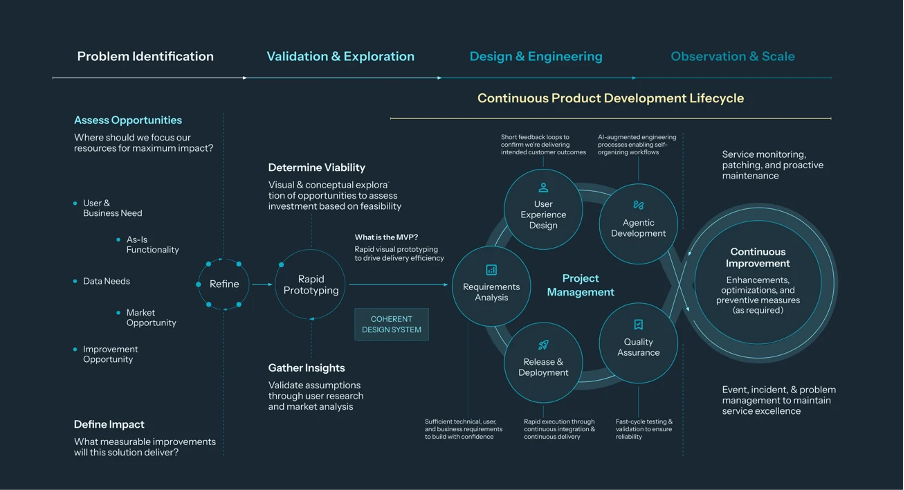
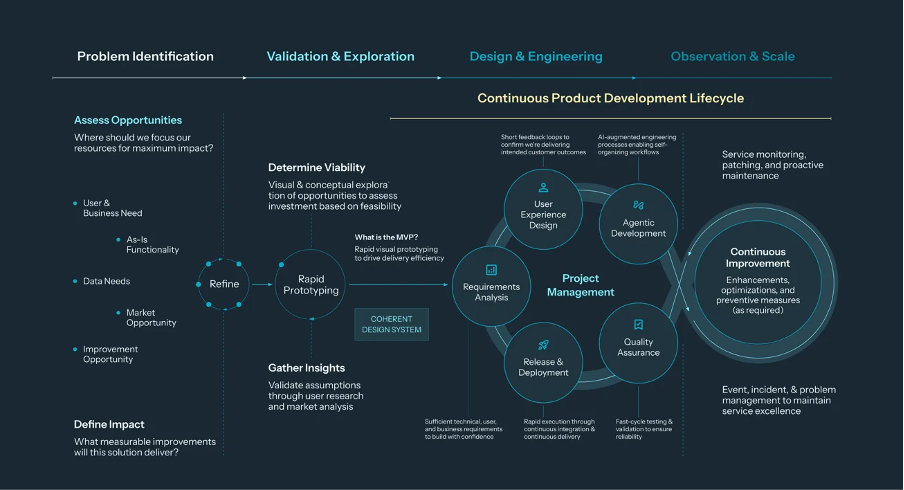
Coherent Solutions, a global digital engineering firm, is one of several technology organizations attempting to address the delivery system problem at a structural level. Its recent whitepaper introduces what the company calls the ‘continuous delivery loop’. This framework replaces fixed handoffs between development phases with recurring feedback across problem identification, validation, engineering, and production observation. The company describes what it calls the ‘digital value gap,’ the space between accelerated developer activity and the enterprise value that activity is supposed to produce.
The company also emphasizes compound learning. Its AI Playbook and engagement-specific AI Starter Kits let lessons from one project inform the next, with support from three organizational roles: an AI Council, Applied AI Experts, and AI Champions.
Coherent Solutions reports an average delivery performance improvement of approximately 30% against each client’s pre-CDL baseline, a figure the company presents as a relative improvement against each client’s own starting point.
What to measure
Lines of code, acceptance rates, and individual time savings measure developer activity, not delivery performance. More useful signals include lead time from idea to production, deployment frequency, defect and rollback rates, and business outcomes linked to specific releases.
The organizations most likely to compound the value of AI adoption are those building mechanisms for institutional learning, capturing reusable governance patterns and project-specific knowledge so that each engagement starts from a stronger foundation than the last.